Monday, October 22, 2007


Sunday, September 30, 2007
Paris Hilton on Letterman
L.S.,
Not usually known for being particularly critical, Letterman takes a few swings at Paris Hilton:
Not usually known for being particularly critical, Letterman takes a few swings at Paris Hilton:
Tuesday, September 25, 2007
NYC Part 1

Search by
Name: HOLTERMAN, JAN
| Last Name | First Name | Entry Number | Accepted? | Age | City | Province | Country of Residency | Team |
|---|---|---|---|---|---|---|---|---|
| HOLTERMAN | JAN | 198951 | YES | M57 | EMMEN | DRENTHE | Netherlands |
Sunday, September 23, 2007
Friday, September 21, 2007
Mark Mardell
Mark Mardell on the Dutch Referendum discussion:
Another Dutch No?
Mark Mardell 21 Sep 07, 12:15 AM
People whistle through the Binnenhof’s cobbled square on their bikes, scarcely giving a glance to either the rather lovely understated architecture or the politicians bustling in and out of the many ministries.
This part of The Hague could be a quiet monument to democracy. Even a rather showy fountain in brown and gold doesn’t undermine the impression of a rather harmonious relationship between the rulers and the people who chose them.
The office of the Dutch Prime Minister in one courtyard, the entrance to the upper and lower houses of parliament in another, various ministries scattered around these two unpretentious courtyards, which have long been the seat of the government of the Netherlands.
But when cabinet ministers meet at Number 19 later today, will they give the people a say over the new European Reform Treaty?
My strong guess is No, but as you’ll see that won’t quite be the end of the story.
The Dutch government is a coalition. The dominant partners, the Christian Democrats, are - like all the governments in the European Union - in favour of the treaty and anxious to avoid a referendum. Gordon Brown too will be hoping they don’t hold one.
It was of course the Dutch who nailed the constitution. Days after the French voted "Non" their "Nee" made sure it was in effect dead. This saved Tony Blair from holding a referendum he never wanted. But a second Dutch referendum now would put wind in the sails of those who want one in Britain and pile the pressure on Mr Brown.
Curious allies
Dutch Foreign Minister Maxime Verhagen, a Christian Democrat, said I would have to wait and see what the cabinet decided but he was sure there would be a unanimous decision.
"We listened to the Dutch public, they said No to the constitutional treaty, now we have a treaty which is completely different," he said. "It is not forecasting a European superstate, there is a clear division between what should be decided in member states and what should be decided in Europe."
The Dutch Christian Democrats have very curious allies in their argument. The Christian Union shot to prominence during the referendum campaign, noisily and successfully championing a No. So you would think their position would be obvious. But they don’t like referendums, and never have.
But it's not just that. One of their MPs, Esme Weigman, told me: "The new treaty is just a modification of the Treaty of Nice, it's another situation from when we had a constitutional treaty. The decisions during the summit in June were very good."
They now have three seats in the cabinet so I suggested that cynics might say the reason for their change of heart was obvious, that they were now part of the government and wanted to stay part of it.
She said, "Yes, people say the Christian Union has changed. But it's not the Christian Union that has changed but the cabinet that has changed on Europe. The most important thing is now Europe will go forward in co-operation but not go forward to a United States of Europe."
The problem for the Dutch government is their Labour Party partners. It's the party's policy to hold referendums. Even though it is for the treaty.
The Dutch parliament is a rather wonderful building, combing old and new with sweeping empty halls and strange giant mobiles hanging in the air. Comfy too: I wish we had had squishy leather sofas and flat-screen TVs during my days at Westminster. It makes the traditional journalistic job of hanging around to “doorstep” ministers a lot more comfortable.
Agonies
The most interesting politician I spoke to was Labour's Luuk Blom. He said: "I’m in favour of a referendum It's part of our programme, referendums are a new way to decided things in a country, to link people more closely to politics. You have to take the people very seriously. The No was a very strong No... I’m in favour of a referendum, and the chances are 50/50."
But he likes the treaty and was obviously in some agonies about what the people might decide if they did get that vote, a view that I think is very common among the political class in the Netherlands, and indeed elsewhere.
"Is it possible to take a No this time? Holland would be in a very difficult position in Europe. We’d be on the bench in football terms. When the Dutch said No two years ago there was a possibility to start new negotiations. That’s not possible any more. This treaty is it. So if we said No, would we be in the European Union? Maybe that should be the question."
The parliament is open to a constant stream of visitors who come to listen to the debates and look at the building. But during the time I was there I never saw anyone approach the displays and the giant yellow flags that cover one wall and part of the floor, emblazoned with the question "Hoezo EU?" ("What’s the EU about?")
There were different views, of course, from those I spoke to, but none of the No-voters said they were happy with the new treaty. In fact none of them mentioned the treaty itself: their complaints were broader.
Professor of political science at the University of Amsterdam Jos de Beus surprised me, telling, me that he thought a referendum was likely. He added: "The mood is Eurosceptic, there is no sense of European identity. There is still a sense that the European space is a space of globalisation, of Islamisation, that Brussels is a superstate. The climate is still quite volatile, so the government is afraid of a second failure. It's still quite easy for the Eurosceptics to win a referendum."
This is exactly the fear of politicians that people, supposedly voting on a technical matter, will give the answer to a big political question, and an answer which most European politicians do not like - and regard in fact as untenable, unpractical, unworkable.
Another Dutch No?
Mark Mardell 21 Sep 07, 12:15 AM
People whistle through the Binnenhof’s cobbled square on their bikes, scarcely giving a glance to either the rather lovely understated architecture or the politicians bustling in and out of the many ministries.
This part of The Hague could be a quiet monument to democracy. Even a rather showy fountain in brown and gold doesn’t undermine the impression of a rather harmonious relationship between the rulers and the people who chose them.
The office of the Dutch Prime Minister in one courtyard, the entrance to the upper and lower houses of parliament in another, various ministries scattered around these two unpretentious courtyards, which have long been the seat of the government of the Netherlands.
But when cabinet ministers meet at Number 19 later today, will they give the people a say over the new European Reform Treaty?
My strong guess is No, but as you’ll see that won’t quite be the end of the story.
The Dutch government is a coalition. The dominant partners, the Christian Democrats, are - like all the governments in the European Union - in favour of the treaty and anxious to avoid a referendum. Gordon Brown too will be hoping they don’t hold one.
It was of course the Dutch who nailed the constitution. Days after the French voted "Non" their "Nee" made sure it was in effect dead. This saved Tony Blair from holding a referendum he never wanted. But a second Dutch referendum now would put wind in the sails of those who want one in Britain and pile the pressure on Mr Brown.
Curious allies
Dutch Foreign Minister Maxime Verhagen, a Christian Democrat, said I would have to wait and see what the cabinet decided but he was sure there would be a unanimous decision.
"We listened to the Dutch public, they said No to the constitutional treaty, now we have a treaty which is completely different," he said. "It is not forecasting a European superstate, there is a clear division between what should be decided in member states and what should be decided in Europe."
The Dutch Christian Democrats have very curious allies in their argument. The Christian Union shot to prominence during the referendum campaign, noisily and successfully championing a No. So you would think their position would be obvious. But they don’t like referendums, and never have.
But it's not just that. One of their MPs, Esme Weigman, told me: "The new treaty is just a modification of the Treaty of Nice, it's another situation from when we had a constitutional treaty. The decisions during the summit in June were very good."
They now have three seats in the cabinet so I suggested that cynics might say the reason for their change of heart was obvious, that they were now part of the government and wanted to stay part of it.
She said, "Yes, people say the Christian Union has changed. But it's not the Christian Union that has changed but the cabinet that has changed on Europe. The most important thing is now Europe will go forward in co-operation but not go forward to a United States of Europe."
The problem for the Dutch government is their Labour Party partners. It's the party's policy to hold referendums. Even though it is for the treaty.
The Dutch parliament is a rather wonderful building, combing old and new with sweeping empty halls and strange giant mobiles hanging in the air. Comfy too: I wish we had had squishy leather sofas and flat-screen TVs during my days at Westminster. It makes the traditional journalistic job of hanging around to “doorstep” ministers a lot more comfortable.
Agonies
The most interesting politician I spoke to was Labour's Luuk Blom. He said: "I’m in favour of a referendum It's part of our programme, referendums are a new way to decided things in a country, to link people more closely to politics. You have to take the people very seriously. The No was a very strong No... I’m in favour of a referendum, and the chances are 50/50."
But he likes the treaty and was obviously in some agonies about what the people might decide if they did get that vote, a view that I think is very common among the political class in the Netherlands, and indeed elsewhere.
"Is it possible to take a No this time? Holland would be in a very difficult position in Europe. We’d be on the bench in football terms. When the Dutch said No two years ago there was a possibility to start new negotiations. That’s not possible any more. This treaty is it. So if we said No, would we be in the European Union? Maybe that should be the question."
The parliament is open to a constant stream of visitors who come to listen to the debates and look at the building. But during the time I was there I never saw anyone approach the displays and the giant yellow flags that cover one wall and part of the floor, emblazoned with the question "Hoezo EU?" ("What’s the EU about?")
There were different views, of course, from those I spoke to, but none of the No-voters said they were happy with the new treaty. In fact none of them mentioned the treaty itself: their complaints were broader.
Professor of political science at the University of Amsterdam Jos de Beus surprised me, telling, me that he thought a referendum was likely. He added: "The mood is Eurosceptic, there is no sense of European identity. There is still a sense that the European space is a space of globalisation, of Islamisation, that Brussels is a superstate. The climate is still quite volatile, so the government is afraid of a second failure. It's still quite easy for the Eurosceptics to win a referendum."
This is exactly the fear of politicians that people, supposedly voting on a technical matter, will give the answer to a big political question, and an answer which most European politicians do not like - and regard in fact as untenable, unpractical, unworkable.
Pajiba
L.S.,
Pajiba is the best review site on the internet, and sometimes they have silly stuff, too.
To illustrate, this is their review of the glorious DOA: Dead or Alive:
Will Someone Please Bash Me to Death With a Truncheon?
DOA: Dead or Alive / Phillip Stephens
In my loftier moments I’ve often wondered if there are any truly redeeming merits to be found in writing about movies. Trying to gauge an art form is a tenuous business, especially when most of our intellectual traditions accept relativism to the degree that ours does. Often film reviews are mired in a subjectivity that bashes or defends their charge based on expectation, personal preference, or any myriad of reasons that can’t rightly fit into an objective mold, even if we assume one exists at all.
To further muddle things, what does one make of a film’s self-consciousness, of its actively choosing style or content that can’t help but draw derision from those who’d judge it against? Is it ridiculous to take a subject matter seriously when those responsible had no intention of extending the viewer the same courtesy?
My point in bringing all this up — DOA: Dead or Alive, a film based on a series of fighting games, is so bad it defies description. Truly, there’s not one line of dialogue that doesn’t grate in your head like bagpipes in a garbage disposal, not one cheap, gratuitous shot of nubile flesh that doesn’t make your eyes roll, not one plot incongruity that doesn’t make you question the existence of a benevolent deity.
The plot is so repellant that I’m not going to waste precious seconds of my life rehashing it. Suffice to say: three women, all of whom are ambulatory tits with no higher-brain function, compete in a fighting tournament and kung-fu kick the Christ out of each other while an evil Eric Roberts (of-fucking-course it’s Eric Roberts) plans to take over the world with sunglasses that can predict the future. Also, Jaime Pressly is top-billed. It’s so ridiculous it just might have worked …
The thing is, there are already hordes of apologists for Dead or Alive who are positively hailing the film for exactly the same reasons I would decry it, mostly those primordial twats who haunt the IMDb message boards: “This movie isn’t trying to win any awards, so why not have fun with it JAYKAYLOLBBQ?” It sounds reasonable, sure, but I personally have a hard time having “fun” with a film that causes me to hate the rest of humanity for tacitly endorsing said fun in such vapid, visceral terms. If you want bikinied bimbos, get some porn; if you want ludicrous kung-fu violence and its accompanying aesthetic, play the same video game this crap is based on; if you want to see Eric Roberts ever work again, please keep that knowledge to yourself and hide your shame from the rest of the world until you’re dead.
Self-conscious stupidity is still stupidity, people, and Dead or Alive is so stupid it would give ass-cancer to lab rats. It’s too big a risk to say that in the proper context this film could be enjoyed, because that context could range from sheer mental ineptitude to the imbibement of lethal quantities of alcohol. Is it fair to ask someone to effectively cripple their cerebrum in the off chance that they would maybe derive some pleasure from this ignominy? I fucking hope not.
Phillip Stephens is the lead critic for Pajiba. He lives in Fayetteville, AR.
And this is something silly I found on their site:
Pajiba is the best review site on the internet, and sometimes they have silly stuff, too.
To illustrate, this is their review of the glorious DOA: Dead or Alive:
Will Someone Please Bash Me to Death With a Truncheon?
DOA: Dead or Alive / Phillip Stephens
In my loftier moments I’ve often wondered if there are any truly redeeming merits to be found in writing about movies. Trying to gauge an art form is a tenuous business, especially when most of our intellectual traditions accept relativism to the degree that ours does. Often film reviews are mired in a subjectivity that bashes or defends their charge based on expectation, personal preference, or any myriad of reasons that can’t rightly fit into an objective mold, even if we assume one exists at all.
To further muddle things, what does one make of a film’s self-consciousness, of its actively choosing style or content that can’t help but draw derision from those who’d judge it against? Is it ridiculous to take a subject matter seriously when those responsible had no intention of extending the viewer the same courtesy?
My point in bringing all this up — DOA: Dead or Alive, a film based on a series of fighting games, is so bad it defies description. Truly, there’s not one line of dialogue that doesn’t grate in your head like bagpipes in a garbage disposal, not one cheap, gratuitous shot of nubile flesh that doesn’t make your eyes roll, not one plot incongruity that doesn’t make you question the existence of a benevolent deity.
The plot is so repellant that I’m not going to waste precious seconds of my life rehashing it. Suffice to say: three women, all of whom are ambulatory tits with no higher-brain function, compete in a fighting tournament and kung-fu kick the Christ out of each other while an evil Eric Roberts (of-fucking-course it’s Eric Roberts) plans to take over the world with sunglasses that can predict the future. Also, Jaime Pressly is top-billed. It’s so ridiculous it just might have worked …
The thing is, there are already hordes of apologists for Dead or Alive who are positively hailing the film for exactly the same reasons I would decry it, mostly those primordial twats who haunt the IMDb message boards: “This movie isn’t trying to win any awards, so why not have fun with it JAYKAYLOLBBQ?” It sounds reasonable, sure, but I personally have a hard time having “fun” with a film that causes me to hate the rest of humanity for tacitly endorsing said fun in such vapid, visceral terms. If you want bikinied bimbos, get some porn; if you want ludicrous kung-fu violence and its accompanying aesthetic, play the same video game this crap is based on; if you want to see Eric Roberts ever work again, please keep that knowledge to yourself and hide your shame from the rest of the world until you’re dead.
Self-conscious stupidity is still stupidity, people, and Dead or Alive is so stupid it would give ass-cancer to lab rats. It’s too big a risk to say that in the proper context this film could be enjoyed, because that context could range from sheer mental ineptitude to the imbibement of lethal quantities of alcohol. Is it fair to ask someone to effectively cripple their cerebrum in the off chance that they would maybe derive some pleasure from this ignominy? I fucking hope not.
Phillip Stephens is the lead critic for Pajiba. He lives in Fayetteville, AR.
And this is something silly I found on their site:
Friday, September 14, 2007
Obsidian Wings
L.S.,
The single best blog about all things Iraq is Obsidian Wings. This is the entry of today:
The single best blog about all things Iraq is Obsidian Wings. This is the entry of today:
Bush's Pointless Speech
by hilzoy
In a move that caught all of Washington by surprise, President Bush announced tonight that he will begin drawing down troops at almost exactly the rate that he must draw them down unless he is prepared to extend troop rotations or institute the draft. In another startling move, he described this drawdown not as forced on him by deployment schedules, but as a "return on success": the tremendous success of the surge. In so doing, once again, our President shows himself to be a true visionary: seeing things invisible to ordinary men and women. Where we see only a country in the process of falling apart, our more discerning President sees success. Where we see millions of people fleeing their homes, he sees 'civil society taking root'. And, somehow, he sees "a young democracy" where we see dead people.
And to top it all off, where we see a President determined to keep our troops in harm's way for as long as possible, hoping that the civil war unleashed by his folly will unfold on someone else's watch, he sees a chance, "for the first time in years, for people who have been on opposite sides of this difficult debate to come together." Although why he thinks this is so novel escapes me: it has always been possible for both sides to come together if all those who disagree with George W. Bush simply abandon their positions, and this is not the first time he has suggested that we embrace this sort of bipartisanship.
The President also said this:"In the life of all free nations, there come moments that decide the direction of a country and reveal the character of its people. We are now at such a moment."
Here, for once, I agree completely. We have had clear evidence that our policy in Iraq is unworkable for some time. We need to decide what to do about it. And we have, essentially, two choices. On the one hand, we can face up to this fact, as unpleasant as it might be, and figure out the most honorable way of extricating ourselves. On the other, we can continue to defer the moment when we have to realize that we have failed, and go on sacrificing good and decent men and women to our unwillingness to face the truth.
This will, as President Bush says, reveal our character as a people. I would much rather it reveal some capacity for maturity and decency than a willingness to ask people to die so that we can pretend we haven't lost.
***
And by the way: don't you love all those youth and growth metaphors? "A young democracy", for instance: if you have a young anything, just give it the food and care and love that it needs, and it will grow. "For lasting reconciliation to take root": if you have a plant, and you set it in good soil and water it conscientiously, its roots will grow. If Iraq were a child or a plant, then the surge -- whose entire aim is to provide the conditions in which reconciliation can flourish and democracy can grow to maturity -- would be exactly what was needed.
When I hear these metaphors, I think: it's as though Bush had planted a stone in fertile soil, and watered it, and said: any moment now, it will put down some roots and begin to grow! Eventually, it will become a boulder!
Thursday, September 13, 2007
Wednesday, September 12, 2007
Stijn
L.S.,
No, he's not mine.
And he isn't my sister's, either.
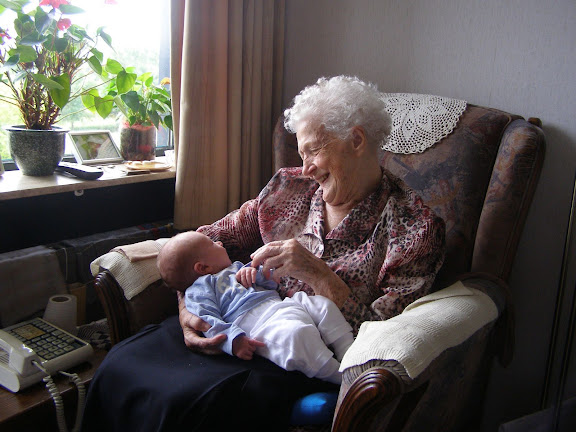
This is Stijn, and his mother is my cousin.

And this is my grandmother (and his great-grandmother):

More Pictures here.
No, he's not mine.
And he isn't my sister's, either.
This is Stijn, and his mother is my cousin.

And this is my grandmother (and his great-grandmother):
More Pictures here.
Subscribe to:
Posts (Atom)